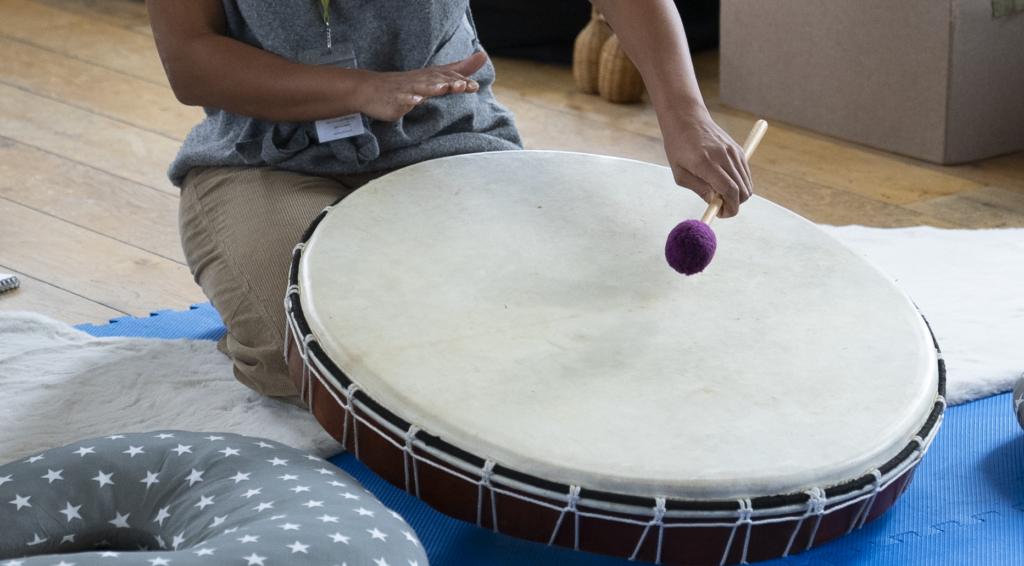
Machines beep incessantly and the air smells of disinfectant. Beds are squeezed close together in the large room, white walls and ceiling blurring together. Someone coughs wetly. The neon lights are sharp, but dim as the curtains are pulled, allowing sunlight to stream in through boxy windows. Hushed conversation quiets as the steady tones of a drum lands in the room.
Since 2024, Arts in Hospital, Dorset County Hospital, and Bournemouth Symphony Orchestra have worked together to bring music to patients at the hospital. Activities not only help brighten patients and visitors’ days, but can help with stroke recovery, ignite memories in people living with dementia, support conversation and connection, and calm young patients.
Ecology in Healthcare
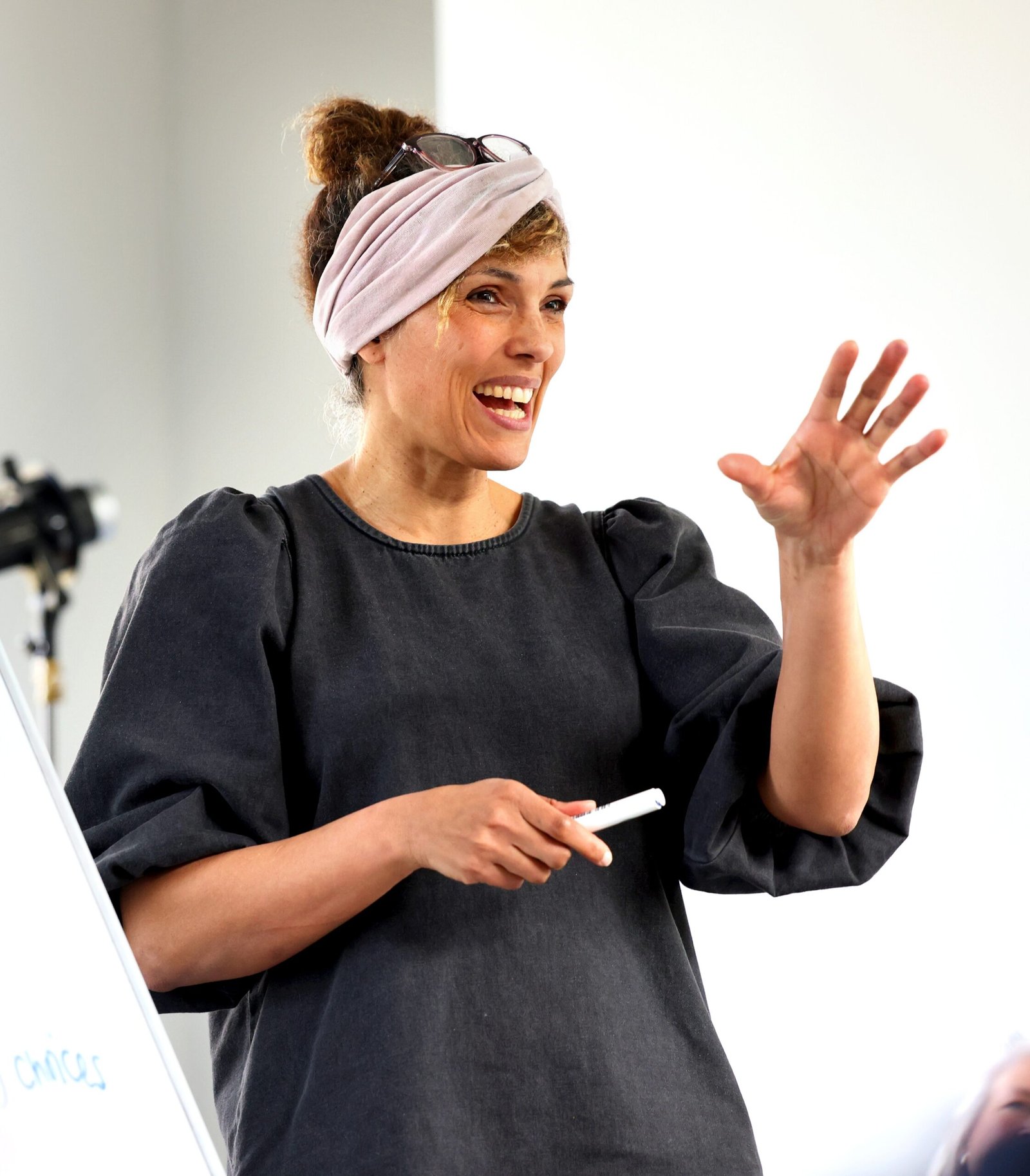
Zoë Palmer is one of the musicians who visits Dorset County Hospital on a weekly basis. I met with Zoë to hear about her practice and her unique perspective on working with music to support people’s wellbeing.
“I’m a multidisciplinary artist working at the intersection of arts, health, and ecology. My approach is grounded and relational. How that applies in the room when I’m working with stroke patients, for example, is that I’m aware of the group dynamics, I’m aware that someone is having a difficult day over there, and that is going to be impacting the person across the room, because we’re not isolated. So, there’s an ecological mindset that I carry into the work.”
“I’m also aware of the impact of the environment on a group setting. I will ask patients if they would like me to turn off the neon lights, because they’re on all the time in some hospital wards. That subtle modification allows natural sunlight to come into the room for that moment when we’re making music. We also open the windows – subtle, gentle interventions. They don’t seem like much, but the idea is that when they come together, it’s about creating an atmosphere that feels very different from the atmosphere on the ward and hopefully that helps to support patients to unlock creativity or a different way of being together in that moment.”
“In our workshops, we hold space for patients to explore movement, breath work, the sound of their voices, and instrumental work which enables them to contribute to a larger musical texture. Music is the container through which we create a safe space. We also think about the desired clinical outcomes, working alongside specialists – occupational therapists, physiotherapists – to support their work through music.”
“For example, often after suffering a stroke, patients struggle with their grip, maybe down one side of their body, so we offer them specific instruments that will support them to improve their grip. We might give them a certain size shaker or a hand chime, and in the process of making music they are not necessarily cognisant of the fact that we are also supporting their specific set of clinical aims.”
“The joy of working with stroke patients is that many of them rehabilitate on an upward trajectory. It’s not the same in the dementia ward, it’s a very different thing.”
“There was a patient on the dementia ward who seemed very disengaged when we first walked in. He was almost frozen in his gesture in the bed. And he looked like he’d been like that for a long time. So we started playing. And over the course of the 20 minutes that we were on the ward, he began moving.”
“By the end of the session he was clicking and applauding us and basically having a dialogue with us with his body and the music, and the staff came in from different parts of the ward to watch, to observe what was happening. They hadn’t seen him respond to anything previously. It was very interesting to get that feedback from the staff, that this was the first time they’d seen a man be so responsive since he’d been in the hospital.”
“We don’t know what that piece of music or what that sonority meant for that man – but for some reason, he started engaging with us, and it was a real privilege to have witnessed.”
The Impact of Music on Health and Wellbeing
Plenty of research has looked into how music can support clinical treatment. Italian neuroscientist, Roberto Gatti, found that auditory feedback is key in improving hand function through movement, as it strengthens pre-existing pathways in the brain connecting movement to sound (Levitin, 2024, p.121). Music-supported therapy not only improves motor control, but also quality of life (Huang et al., 2021, p.10), and rhythm-centred music making, specifically, has been shown to reduce stress, anxiety, and blood pressure, as well as promote feelings of empowerment and higher energy levels (Yap, Kwan, and Ang, 2017).
“We know the scientific evidence base is there. On an intuitive level, an anecdotal level, I see the impact in people from the beginning to the end of our sessions. And I’m not saying it’s all rosy all the time, because it isn’t, because sometimes music can be triggering or traumatic for people, depending on their life experiences. All of the work we do comes from a trauma-informed perspective, and there’s a lot of emphasis on patient-led approaches. It’s about eliciting and giving as much agency in the creation process as we can.”
“The arts create the space for wellbeing in part because of the agency they give people. Particularly in clinical settings, people are stripped of agency by virtue of being there. For me, the creation of agency is really at the core of wellbeing, of recovery and healing, and it’s about recalibrating the balance, so people can make choices that support them to heal themselves. Like many others working in creative health, and in the field of music therapy, I believe that the unique properties of music and sound have a role to play in both personalised and collective recovery.”
“It’s my personal belief that often people know what they need, and if you give them some instruments, they will know which sound they need on that day to make their minds feel better. That’s my intuitive sense, but there is strong scientific evidence base that proves all the physiological benefits of music – cortisol rates dropping, dopamine increasing, oxytocin increasing.”
The Art of Making People Feel Comfortable
Zoë laughs when I ask her how she makes people feel comfortable during a workshop. “I feel like that’s a question for the people there. I try and make an invitation to collaborate. I try to minimise expectation and pressure. At the core of my practice is cultivating a sense of safety, authenticity, and vulnerability. Vulnerability is a key.”
“I try and model perfect imperfection, creating a sense of us muddling through together, whilst also being professional and safe and reliable – so it’s a balance of all those things.”
“I don’t need to do that with words. That’s where the music and, particularly for me, where rhythm comes in, and percussion. You give a group a beat and they will entrain and lock into that beat, they will feel safe – it’s biological, right? There will be a sense of safety that comes just from having that rhythm that they can lock into, so I rely on percussion a lot, to do a lot of that unspoken holding.”
“The rest of it is more modelling a kind of gentle humour and imperfection, I guess, and giving everyone the permission to just play.”
“I know that’s not always easy for some people. So I do name things sometimes. I do say to people, okay, we’re going to do some improvising now. It might feel a bit eggy. You might feel a bit uncomfortable. We don’t know what we’re doing. If we’re making up a new song, for example, you have to sit in the discomfort and the ambiguity for as long as possible. Some people really can’t tolerate that, it’s really difficult for them.”
“You see people relax when you name these more uncomfortable feeling, because naming them helps take the anxiety off them and say: don’t worry, we know this is a thing.” She laughs. “I guess it’s that and some general compassion.”
Zoë’s Path to Creative Health Work
“I got there by following different strands of curiosity and interests over the years and generally coming from a kind of broadly ecological perspective, the essence of which for me means that everything’s interconnected. And so when I pull on one string, all the other strings reverberate at the same time. I’ve followed three strands: music, wellbeing, and ecology, and my practice has emerged from weaving those strands together.”
“Health and wellbeing has been a core thread that has run through my work from the very beginning. It’s something I’m very passionate about, the transformative power of the arts and the power of the arts in creative health – to support the whole ecosystem, to support nurses, doctors and the environment, to support cleaners, porters, receptionists, everyone working within clinical ecosystems within the scope of our practice.”
Learning from Experience
“When we first started this work 15 years ago, there wasn’t the same knowledge in place of like, what we would need as practitioners, so although we did have debriefs and things like that, it just wasn’t the same structural support in place. I burnt out because I didn’t know how to look after myself and I did too much work.”
“What’s helped me recover,” she says, after a sip of her tea, “is to attend to my own practice at the same time, and to take the whole trauma-informed practice that I mentioned; to apply that to myself, keep a balance.”
“I’m much more selective about who I work for these days and I’m lucky I can afford to be selective in that position now in my career. I know it’s difficult when you’re younger and you’re establishing yourself, but I’m quite selective about who I collaborate with, because I know that really impacts the quality of the work.”
“For me, it was about stabilising my nervous system so that I didn’t get pulled around by all of the experiences on the wards. My training as a sound therapist, and learning how to use sound to stabilise my nervous system, and breath work. I’ve now got my own toolkit that keeps me well.”
“I do share some of that approach. With the mums and postnatal depression work, it’s really linked, the mental health and emotional wellbeing and somatic wellbeing underpinned by polyvagal theory. That’s the process I’m working with: nervous system regulation through breath work, music, and sound.”
“I’m interested in the idea that the potential in humans is kind of limitless and we cannot make assumptions about people just based on the context they’re in or based on how they look or anything we’re presented with at face value. I’m always trying to get any assumptions out of the way and just actually meet the person who’s in front of me and allow them to unfold.”
It was incredibly insightful to get the opportunity to talk to Zoë about her experiences in the field of creative health, especially how she uses her knowledge of the environment and her intuition to inform her practice. You can find out more about Zoë and her work on her website.
References and Further Reading
Huang, W., Dou, Z., Jin, H., Cui, Y., Li, X., and Zeng, Q. 2021. The Effectiveness of Music Therapy on Hand Function in Patients With Stroke: A Systematic Review of Randomized Controlled Trials, Frontiers in Neurology, v12, pp.1-11. Doi: 10.3389/fneur.2021.641023.
Levitin, D. 2024. Music as Medicine: How We Can Harness Its Therapeutic Power. London: Penguin Random House.
Yap, A., Kwan, Y., and Ang, S. 2017. A Systematic Review on the Effects of Active Participation in Rhythm-Centred Music Making on Different Aspects of Health, European Journal of Integrative Medicine, v9, pp.44-49. Doi: 10.1016/j.eujim.2016.11.011.
As this is a new publication, we would love to hear from you regarding what you would like to see in the future. Let us know on our contact page.
Leave a Reply